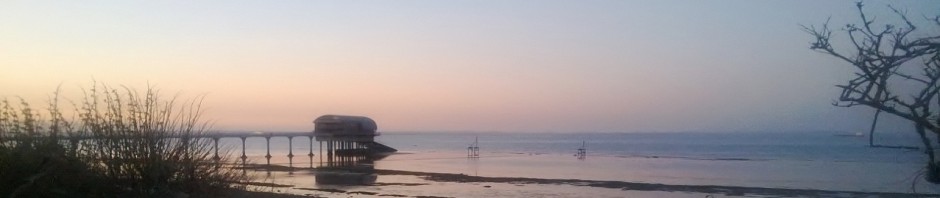
Waves and the ocean

…[T]hink of the vast ocean. There are waves that are catastrophic, there are little ripples, there is water crashing on the shore, but it’s all unquestionably ocean. The ocean is whole. I think this is one of the reasons humans love to look at the ocean: somehow the usual sense of “me” and “that” dissolves naturally. There’s still some kind of subject-object sensibility there, but it softens. And there’s something about that that we as a species fall in love with. We love that vastness, and there’s actually a very deep yearning for it. [We’re] nourished by the experience of wholeness.

Anne C Klein, Tricycle Magazine, August 2023

It is hard even to write of these things without sounding slightly silly, but somehow the image of waves and the ocean has, for as long as I can remember, had for me this sense not only of wholeness, but of ultimate security. The wave cannot fall out of the ocean; however much “subject-object sensibility” it manages to retain, it remains water. The awareness with which we are aware – of sense impressions, thoughts, emotions, whatever, even when we are asleep and dreaming – is the awareness within which all appearances arise.

To be still, listening, beside the open ocean, is all it takes; then our fretful wavelets still for a moment, if only between one breath and another, and we can sense the non-differentiation of Istigkeit, the unending of no thing. We are not other than what is.

Losses

We dream of immortality because we are creatures made of loss — the death of the individual is what ensured the survival of the species along the evolutionary vector of adaptation — and made for loss: All of our creativity, all of our compulsive productivity, all of our poems and our space telescopes, are but a coping mechanism for our mortality, for the elemental knowledge that we will lose everything and everyone we cherish as we inevitably return our borrowed stardust to the universe.

And yet the measure of life, the meaning of it, may be precisely what we make of our losses — how we turn the dust of disappointment and dissolution into clay for creation and self-creation, how we make of loss a reason to love more fully and live more deeply.

Maria Popova

I have long felt that losses, not only the losses inherent in mortality, but the little everyday losses that go with being human and alive – the loss of times past, of old haunts one may never revisit because they are not the same any more, the loss of old lovers, of once treasured possessions, of whole phases of life that cannot now be relived – are no more and no less than the fabric of meaning itself. They are the juicy realities that life is actually about, just as much as the joys of being alive and the wonders of illumination.

Richard Norman, in his excellent new book What is Humanism For?, quotes Martin Hägglund:

Far from making my life meaningful, eternity would make it meaningless, since my actions would have no purpose. What I do and what I love can matter to me only because I understand myself as mortal. … The question of what I ought to do with my life – a question that is at issue in everything I do – presupposes that I understand my life to be finite. … If I believed that my life would last forever, I could never take my life to be at stake and I would never be seized by the need to do anything with my time.

One loss we can never avoid is that of our own life, sooner or later; for many people this is in itself an appalling prospect, and yet it may be in the end the only thing that makes life – our one and finite life – worth living. Death, as I’ve written elsewhere, is no enemy, but the truest friend we have:

Death is an old friend. To dissolve in the end into simple light, the plain isness that underlies all things and yet is no thing: what is there to fear? Death follows us, yes, but he is our own death; dear, familiar, kind, and faithful.

Perhaps it is good to make friends with death for ourselves: to greet him first thing in the morning, say goodnight; check in with him when we wake during the night. He won’t be asleep.

Not knowing

In order to explore different dimensions of not knowing, we have to establish and cultivate a willingness to put aside what we may think we already know—about ourselves, the world, Buddhism, or dharma practice—to really engage with what we don’t know.

Consider the range of views you may have about dharma practice, or about Buddhism, for example. There could be a religious view: one that attempts to describe reality, and maybe gives us codes of behavior for how to be in that reality. You may or may not subscribe to a religious view of Buddhism.

There’s a philosophical view that attempts to understand reality rather than simply describe it. A philosophical way of knowing about Buddhism, for example, is replete with ideas: those many lists of the eightfold path, the five precepts, or the four noble truths. In all the ways we can find those views helpful, or illuminating, they can also just reinforce a knowing about, a knowledge-based view, or a philosophical view.

The self-help view of Buddhism, which may be the way many of us have first engaged with dharma practice, is designed to offer a better way to cope with reality, rather than trying to merely describe or even understand reality. In this view, one hopes to put aside some of their confusions, neuroses, and difficulties. You hope to cultivate certain mental and emotional skills, so as to better meet the life around you, the people around you, the world around you, and the world within you.

There’s also what we could call a liberation view that—in addition to describing reality, understanding reality, and better coping with reality—points us to that capacity to fully merge with reality and to know a freeness as we navigate through reality. On the one hand, liberation view is about this one, brief, lifetime, and on the other hand, it’s also about the immensity of consciousness, of awareness, and the knowing of all time and space as being available right here.

This “right-here-ness” is the open doorway, a portal to fully meeting reality. We can access a living engagement with right here through our capacity to not know. To put aside the familiar, the well-worn, the conceptual, and the habitual, and instead engage with the immediate, the mysterious, the constantly surprising, and the conceptually ungraspable.

Martin Aylward, ‘Why We Should Turn Towards Mystery’, Tricycle Magazine, February 2023

To live quietly, away from the maelstrom of news and rumour, paranoia and opinion that seems to constitute social and public media, appears to me to be the best ground for cultivating the mystery. Practice, silence and stillness flourish in these long, quiet days of my retirement; but they can too in moments of quiet in a busy life – on the bus, perhaps, or sitting alone in a city square during lunch hour.

Lewis Richmond writes of the early days of the recent pandemic,

As terrible as that period was, I did notice that it resembled certain qualities of the monastic life with which I was familiar. There were few distractions. Life was simple; we got up, made our meals, dusted and cleaned, and sat after dinner in silence together without much distraction. We didn’t watch TV. We discovered that that enforced quiet was paradoxically the most genuine way to be connected with the world, which was living through the same angst that we were.

For me too, this was a strangely fruitful time. (You can read something of my own experience here.) Connection to the world does not require connection to the firehose of the media; it merely requires the deep awareness of the mystery of being, the unknowability of life itself – the curious realisation that however close one may grow to another person, their own inner world is forever theirs, and you can only know of it what they choose to share, or what you can yourself deduce, nothing more. And yet this existential aloneness is the community we share; it is what it is to be human.

These are things that can only be found in stillness and waiting. Our long hours of practice are nothing more than this; they are no more like the bright awareness beneath all phenomena than soil is like the flowers of the hebe bush, but they are just as necessary.

Emptiness?

Emptiness is not a denial of existence but a subtler perspective that all phenomena are impermanent and interrelated.

Miranda Shaw, “Mothers of Liberation”
Tricycle Magazine, Summer 2007

Emptiness should not be confused with nihilism, which asserts that nothing has any intrinsic value or meaning. Buddhism does not deny the conventional reality of the world nor the importance of ethical conduct; Its doctrine of emptiness simply asserts that the true nature of things is characterized by interdependence and lack of solid, independent existence. It doesn’t deny that things exist; it describes how they exist.

Buddhism A-Z: Śūnyatā, Lion‘s Roar

By these reckonings, Śūnyatā is remarkably similar to distributed causality in modern physics…

To sit quietly, though, is to observe this for oneself. Reading the words alone skitters on the surface skin of an idea. Only watchful stillness can reveal the undeniable, empty nature of conditioned things: the fleeting impermanence of the breath, and of the earth itself – even of the bright stars, so distant that by the time we see them they may no longer even be there. And yet not a thing exists without its antecedents, not even without the things that share its time. But things, truly, are not; there is only pattern, becoming, the bright ground that is no thing. What more could there be?

Quietly

This body is undeniably growing older, gradually disintegrating, moving toward its eventual disappearance, like a wave merging back into the ocean, which it never actually left. This growing up and growing old—like the ocean rising, cresting, and falling—is a movement in time, and time turns out to be a kind of imagination, a way of conceptualizing or thinking about what is happening. The only actual reality is the eternity of Here-Now, this one bottomless moment, from which we never depart, except in imagination, and that imagining only happens now…

As the body ages, I become in some ways more limited. I know, for example, that it’s too late to go to medical school, and I know that there are many people and places dear to my heart that I will never see again. That vast realm of future possibility is closing down and shrinking. And as I wrote about in my last book, Death: The End of Self-Improvement, that limitation is actually a blessing. It forces us to find freedom and fulfillment right here in this very moment.

And indeed, I feel increasingly unlimited in a deeper sense. I’ve been freed from the seductive allure of future possibilities. I’ve been brought home. I find myself ever more deeply appreciating the simple moments of love and joy in everyday life—a few words exchanged with someone I pass on my morning walk… the gorgeous song of a bird and my own heart leaping with joy on hearing it and another bird responding, the three of us somehow dancing together in a field of love… sitting later in my armchair, seeing the shadows of a flock of birds passing quickly again and again over the walls of the buildings across the way, shadows flashing out of emptiness and vanishing, and each time, the heart again leaping with joy, while the green leaves on the red bud tree outside my window shimmer in the light and the breeze. How simple it all is.

Joan Tollifson

Increasingly I feel that Tollifson is right, here. Growing old, I have been brought home in some strange way. Without entirely withdrawing, in the eremitic sense, from life and community, I seem to have found a peace in the midst of things that I had not expected to find.

How much of this rest and quietness of heart is down to aging, or to good company; how much is due to practice, and how much to sheer grace I have no idea. I don’t really know if those distinctions make any sense, even in their own context. I do know that I would not exchange these days for any, or all, of the days of my youth.

The last light of evening between the trees is a soft lilac grey, a colour beyond imagining, that will last only minutes now. The fringe of ragged cloud above is darkening moment by moment, and the birds have gone quiet, even our neighbours the seagulls who breed and roost on the buildings across the road. After what seems like weeks, the air is cool and damp. There is more rain on the way.

Practice, silence, stillness

I remember one afternoon as I was sitting on the steps of our monastery in Nepal. The monsoon storms had turned the courtyard into an expanse of muddy water, and we had set out a path of bricks to serve as stepping-stones. A friend of mine came to the edge of the water, surveyed the scene with a look of disgust, and complained about every single brick as she made her way across. When she got to me, she rolled her eyes and said, “Yuck! What if I’d fallen into that filthy muck? Everything’s so dirty in this country!” Since I knew her well, I prudently nodded, hopping to offer her some comfort through my mute sympathy.

A few minutes later, Raphaele, another friend of mind, came to the path through the swamp. “Hup, hup, hup!” she sang as she hopped, reaching dry land with the cry “What fun!” Her eyes sparkling with joy, she added: “The great thing about the monsoon is that there’s no dust.” Two people, two ways of looking at things; six billion human beings, six billion worlds…

Anyone who enjoys inner peace is no more broken by failure than he is inflated by success. He is able to fully live his experiences in the context of a vast and profound serenity, since he understands that experiences are ephemeral and that it is useless to cling to them. There will be no “hard fall” when things turn bad and he is confronted with adversity. He does not sink into depression, since his happiness rests on a solid foundation.

Matthieu Ricard, Happiness: A Guide to Developing Life’s Most Important Skills p.22

It seems to me that the inner peace Ricard speaks of here is found only through practice, silence, stillness. There is no other way that I have found in all these years.

The gold standard for peace is the kind you touch in the nearness of death. The wonder that opens out when your own death appears to you unavoidable is not only the truest test of peace, but its strongest foundation. After that the interior life holds, despite pain, fear, disgrace, privation. I have been in a few bad spots over the years, and it seems that this remains so: it is the interior life that determines whether we find hope or despair, anxiety or grace. Even the inward experience of physical pain, whatever its outward sensation, seems subject to this pattern. In the end, all that can happen amounts to an appearance on the bright skin of awareness.

This sort of thing, of course, is how people can speak of odd, paradoxical things like gratitude for suffering. This is not some kind of perversion, or worse, some kind of Pollyanna wishful thinking; it is the discovery Ricard has made: that the life of inner peace is the surest underpinning. If that holds, then death has lost its sting – it can only be the wonder of that deep stillness, beyond the last glitter of the little waves.

Einklammerung

At its core, the epoché (from the Greek word meaning “suspension”) refers to the act of suspending or “bracketing” all judgments and assumptions about the world. This suspension is not about doubting the existence of things, but rather about setting aside all preconceptions, biases, and taken-for-granted beliefs. In other words, it is the process of withholding judgment about the nature of the external world to focus on pure experience itself.

For Husserl, the purpose of epoché is to return to a more original, direct experience of phenomena, where the subjective and the objective are not yet split. By “bracketing” or suspending the natural attitude—the everyday way we engage with the world based on assumptions—we can get to the essence of our experiences, as they appear to consciousness, unmediated by theoretical frameworks or prejudices.

Epoché in Phenomenology: Husserl’s Method of Suspension

Einklammerung, bracketing, epoché – is Western phenomenology’s version of the Heart Sutra‘s “Form is emptiness (śūnyatā), emptiness is form”, perhaps. For Edmund Husserl the act of bracketing was not an intellectual curiosity, it was a means to what he called “transcendental consciousness” or “pure consciousness” – something very close to the Dzogchen concept of Rigpa, “the pristine awareness of the fundamental ground itself.” (Wikipedia)

Once we have performed the epoché, we are no longer tied to the particularities of the world. Instead, we can see the world as it is constituted by our consciousness. For Husserl, this is a profound insight, as it reveals that the world is not something external and independent but is, in some sense, dependent on consciousness for its very existence. The epoché uncovers the transcendental nature of experience, which has profound implications for how we understand reality and our place within it.

Epoché in Phenomenology (above)

Western philosophy is prone to run aground on the shoals of terminology and syntax. The simplicity of just sitting, in plain awareness of the moment’s breath, of the sounds beyond the window, the movement of the air, without naming them, without distinguishing them as objects or processes or implications – the Einklammerung happens all by itself, without struggle or willpower; just in the mere being there, in showing up, no more and no less, morning and evening, and sitting there, in stillness. Nothing else.

Gifts of hiddenness

As I grow older, I’m struck more and more by the heroic effort ordinary people are making every day: the people here at the retirement community where I live who are walking with walkers, recovering from strokes or falls or dealing with Parkinson’s or MS…

Many of us noticing the time it takes now to do things once done quickly and the enormous effort to do things that once seemed easy and some of us requiring help with our most intimate tasks. So much we once took for granted is gone. And the gift hidden in this, as I’ve said before, is that we are brought home to right here, right now, just this, just as it is—finding the beauty, the joy, the freedom in the midst of limitation.

Joan Tollifson

Epicurus’ phrase, lathe biōsas, “live in obscurity”, is coming more and more to describe the way I find myself not only living, but being profoundly grateful to live. Growing older comes of course with all the limitations Joan Tollifson describes, but just as she says, it is full also of hidden gifts; gifts of hiddenness, in fact.

Like Tollifson, we too live in a retirement community, and many of the friends we made when we moved in here ten years ago are gone now, whether dead, or just moved on to a care home. We are among the youngsters here, I suppose, and we are still relatively capable. But to live where achievement, acquisition, progress is no longer expected is in itself a blessing. There is no need to explain, no need to prevaricate. Contentment is not seen as a character flaw.

In such a setting, the freedom to study, to practice, to write comes easily. Silence and stillness are gifts too, and as precious in themselves as the soft scented air of evening through the window, the little sounds of birds settling in for the night, the soft tapping of my keyboard. To be alert to the infinite in the tiny moment, the limitless ground beneath each breath; these are mysteries within the plain fragments of passing time that no one would suspect who didn’t live among them, obscurely and at peace.

Sounds

This evening the sounds from the open window were clear and somehow more present than they often seem. The traffic from the road not a hundred yards away sounded almost like the tide on a shingle beach, only not so regular. The birds were quiet, though; the magpie family in the biggest of the hazels at the back of the garden were having a quiet (for magpies) conversation, and there was a blackbird trying a few desultory phrases, but his heart wasn’t really in it. A summer breeze rustled the leaves from time to time.

Sitting by the window, especially in summer, is full of these beloved instants. Even the familiar chair, and the floor beneath my feet, are gifts of love, somehow. Living beside a relatively busy main road through the town, and in distant earshot of the Bristol trains, there are always background sounds, some indefinite as the breeze, and some as clear and unmistakable as the buses that grumble away from the two nearby stops, one on either side of the road – on hot days with their air conditioning units whining with that particular, slightly panicky sound they have.

Somehow these sounds have grown to be as familiar as breathing. They are not noise; there is nothing they are disturbing – least of all me – and yet they are not really background either. I suppose it’s just their place in the dear fabric of what is that holds them there for me. I have learned not to tell stories about them to myself, that’s part of it. What they are is their own whatness; in a sense it is none of my business, and yet I am as much a part of the day as they are. We share this pool of Dorset air, its frequncies and its warmth, the movement of the breeze. We are together while I sit, morning and evening, the sounds and I. What more could I want?

Release

One of the English translations often offered for the German philosophical term Gelassenheit is “releasement”. Martin Heidegger seems to have used Gelassenheit to indicate both a “releasement to” and “releasement from”: in contemplation we are released from our need to classify and arrange our experience, but we are released to the mystery, the wordless isness beneath all that comes to be.

“It is in meditative contemplation that we are open to Being, and in the steadfastness of being open, are exposed to it (i.e., Being). What reveals Being, is therefore, as Heidegger would say, an ‘in-dwelling’ in Being itself.” (Viktorija Lipič, An exploration of Gelassenheit through Meister Eckhart and Martin Heidegger) This seems to me remarkably close to the Dzogchen concept of Rigpabeyond attributes, the clear and undisturbed awareness of the ground.

Even in our own practice, this releasement from and releasement to takes place almost without our taking note of it. We are released from the need to solve our thoughts, satisfy our longings, escape our fears; and released to the stillness of open awareness, the radical acceptance (Brach) of what actually is. It is just that simple, for all the high-flown words we are tempted to decorate it with.